instagram facebook
Powered by Blogger.
  • About Us
  • Natural Dyes
  • Stores & Hours
  • maiwa.com
  • School of Textiles
the MAIWA JOURNAL
Registration Opens June 22 at 10am.

2015 Maiwa Textile Symposium
Workshop Advanced Rug Hooking
Michelle Sirois-Silver

$$295 includes 75 lab fee
November 13, 14, 15, - Class Limit 12
Maiwa Loft: Above the Net Loft, Granville Is. Vancouver BC


In this workshop hand-hooking artists will expand their repertoire of materials and techniques.

Embracing a bold and expressive approach, participants will explore two- and three-dimensional forms. Students will work with alternative materials to incorporate qualities such as texture, depth, tone, and colour into their hooking. The course will cover the different methods needed to fully integrate these materials.  

Advanced rug-hooking will focus on exploration and experimentation. Students will assemble a sample book that includes materials, resources, and methods. Each day students will design and make small art pieces (6x6 inches).  These art pieces will combine the hand-hooked surface with techniques such as hand stitch, needle felt, and the fixing of metal grommets and wire. Hand-hooking will be done with a range of materials from traditional wool fabrics, synthetics, and cottons to leather.

Michelle has packed the three days as fully as possible. This is an intensive workshop designed to challenge the artist. Rug hooking experience is necessary. 


Instructor Bio

Michelle Sirois-Silver is a McGown-certified instructor who teaches rug-hooking workshops on design and colour planning in Canada and the United States.

Her work has been exhibited at fibreEssence, Contemporary Craft in BC, Surface Design Traveling Exhibition, FibreWorks Gallery, Convergence, Gibsons Fibre Arts Festival, and the Silk Purse Arts Centre. She has a Creative Arts Diploma from Vanier College, a BA Specialization in Communications from Concordia University, and a Public Relations Certificate from the University of Toronto. She studied colour theory with Michele Wipplinger and at BC Open University. Ms. Sirois-Silver first began teaching rug-hooking in 1998 and formed Big Dog Hooked Rug Designs in 2004. 
www.michellesirois-silver.com


Friday, May 15, 2015 No comments

On Tuesday May 5th we ran our first Indigo Social. Organized by Sophena Kwon, the evening took place in the soon-to-be Nectar Juicery in east Vancouver. It was promoted via the Maiwa Instagram Feed and was a huge success. Be certain to follow us to see when the next IndigoSocial pops up (#indigosocial).

Participants used a variety of shibori techniques to pattern cotton scarves with a fresh indigo vat using natural indigo. Just to make things tricky ... we had no access to running water on this evening. We worked with a row of pails, using the same techniques we use when we teach in countries where water is scarce.

Here are some photos of the evening (thanks to Britney Gill for sending them on).

We freely distribute our instructions for working with indigo and woad and also our instructions and recipes for a variety of organic indigo vats.


Sophena Kwon and Danielle Bush (directly above) will also be teaching the Journey into Indigo workshop at the 2015 Maiwa Textile Symposium. Complete registration information will be posted on this blog. Registration opens June 22nd, 2015.


Thursday, May 07, 2015 No comments
Registration Opens June 22 at 10am.

2015 Maiwa Textile Symposium
Workshop The Complete Feltmaker
Rene Evans

$$325 includes 100 lab fee
November 9, 10, 11, - Class Limit 14
Maiwa East: 1310 Odlum Drive, Vancouver BC


Felt is one of the oldest known forms of manipulated fibre. Felting appears coincidental with animal husbandry and produces a range of items from clothing and toys to sculpture, tents, and even industrial tools. Often an art and tradition of nomadic peoples, felting is making a worldwide resurgence and is gaining recognition.

Today the lines between feltmaking and the other textiles arts are beginning to fade. Felt is being sculptured into three-dimensional forms with multiple layers. It is being pleated and resist-dyed with shibori techniques. Industrial felts are being used to make structural furniture, while gossamer felts are becoming lighter and lighter. The nature of felt, what it is and what it can do, is being continuously challenged.

In this three-day, sample- and project-oriented workshop, students will explore the many aspects of felt. They will learn basic feltmaking techniques by working with a variety of weights and wool fibres. They will work with art felt and three-dimensional felt suitable for hats, boots, and bags or other art objects, and with lightweight and gossamer “nuno” felts. Students will then select a final project to develop one of the felting techniques covered in the workshop.


Instructor Bio


Rene Evans was born and educated in New Zealand. Rene Corder Evans has always had a love for fine wools, but it was not until she returned to weaving in 1995 that she developed a deep love and appreciation for the art of felt making. In 1996 she was introduced to the Fashion Design Program at the University of the Fraser Valley (UFV), graduating with a Diploma of Fashion Design in 1999. From 2001 to 2012 Rene was a Textile Instructor within the Fashion Design Program at UFV. She divided her time between creating one-of-a-kind wearable art pieces, teaching weaving at the university level, and her career as a business administrator, enjoying the challenges of all three. In 2012 Rene retired and now she spends time in New Zealand and Canada and is finding more time for textile arts.

Monday, May 04, 2015 No comments
Registration Opens June 22 at 10am.

2015 Maiwa Textile Symposium
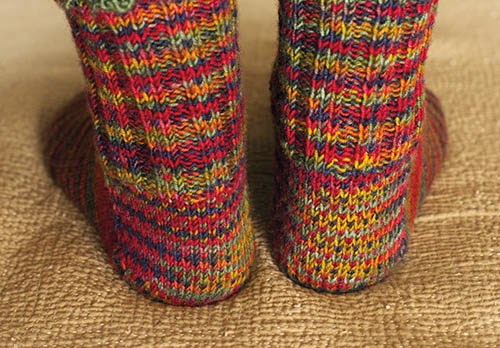
Workshop A Study in Socks
NaomiBelle Rozell

$195 includes 50 lab fee
November 7, 8, - Class Limit 15
Maiwa Loft: Above the Net Loft, Granville Is. Vancouver BC


Sock, Chaussette, Calcetín, Socken, or Calzino.

No matter what language is used, a sock is defined as a garment for the foot and lower part of the leg. In modern times, socks are typically knit from wool, cotton, or nylon yarn.

Basic sock-architecture is the same for all socks. What changes is the method of construction: there are many ways to cover this oddly shaped part of the human anatomy.

In this two-day workshop, we will begin with an in-depth study and exploration of the elements that make up the human foot and lower leg—looking closely at how each of these elements relate to each other.

Using two circular needles and springy wool yarn (spun specifically with socks in mind), we will begin to knit from the tip of the toe moving upwards through each element of the foot to the lower leg.  The end of the first day will yield a completed baby-sized sock that will serve as a template for future sock-knitting. On day two we will examine our own feet closely, taking careful measurements.

Using all that was learned in day one and armed with needles, colourful wool yarn, and an abundance of enthusiasm, we will begin to design and knit a pair of socks just for ourselves.  Our ultimate goal is to achieve a beautifully fitted garment for our feet that will bring delight each and every time we slip our feet and wiggle our toes into the depths of a custom-fitted sock.

Students need to know how to knit and purl and execute basic increases and decreases. Students will have successfully worked a knitting project in the round.


Instructor Bio

Naomi Rozell cannot recall a time when creativity was not part of her daily life.  Although she works with many types of crafts, most of her days are taken up with knitting. You can find her most Saturdays in Maiwa’s Supply Store in the Netloft on Granville Island. 


She dedicates her work to her mother who knit her father’s dress socks for much of their married life. As Naomi writes, “Although I did not learn to knit from my mother, she is my inspiration for sock knitting. I well remember her putting aside her coffee cup and novel (yes, she read while she knit) as she focused on ‘turning the heel.’ Once complete she propped up her book, poured a fresh cup, and resumed her knitting as she read and enjoyed her coffee.  I can still hear her needles coming in contact with each other creating stitch after stitch after stitch.”
Monday, May 04, 2015 No comments
Registration Opens June 22 at 10am.

2015 Maiwa Textile Symposium
Workshop Rug Hooking
Michelle Sirois-Silver

$195 includes 65 lab fee
November 5, 6, - Class Limit 15
Maiwa Loft: Above the Net Loft, Granville Is. Vancouver BC


The original hooked rugs were a matter of thrift. Yet they left a legacy rich in personal history and storytelling.

In this two-day workshop, students learn the basic rug-hooking and finishing techniques needed to make their own hand-hooked rugs and accessories. The class will hand-hook fabric strips onto a linen backing.

Each student receives one-on-one attention from the instructor. Students may select from one of three designs provided by the instructor or are welcome to create their own design. They will leave the workshop with a completed, hand-hooked, 20 cm x 20 cm sampler. Topics covered in the workshop include fabric selection, backing, the sourcing of supplies, and the history of hand-hooked rugs in Canada.

This two-day workshop is ideal for those who are beginners as well as those who have not hooked in a while and want to refresh their skills.


Instructor Bio

Michelle Sirois-Silver is a McGown-certified instructor who teaches rug-hooking workshops on design and colour planning in Canada and the United States.

Her work has been exhibited at fibreEssence, Contemporary Craft in BC, Surface Design Traveling Exhibition, FibreWorks Gallery, Convergence, Gibsons Fibre Arts Festival, and the Silk Purse Arts Centre. She has a Creative Arts Diploma from Vanier College, a BA Specialization in Communications from Concordia University, and a Public Relations Certificate from the University of Toronto. She studied colour theory with Michele Wipplinger and at BC Open University. Ms. Sirois-Silver first began teaching rug-hooking in 1998 and formed Big Dog Hooked Rug Designs in 2004. 

www.michellesirois-silver.com

Monday, May 04, 2015 No comments
Registration Opens June 22 at 10am.

2015 Maiwa Textile Symposium
Workshop Down the Silk Road
Carol Soderlund

$595 includes 150 lab fee
November 4, 5, 6, 7, 8 - Class Limit 16
Maiwa East: 1310 Odlum Drive, Vancouver BC


This is an opportunity to journey with precision dyer Carol Soderlund Down the Silk Road. In her own words:

“Let’s adventure together down the Silk Road, learning all about silk, that lovely seductive cloth which intrigues us with its lustre and sensuous drape. On our journey we will use Procion MX dyes as a reactive dye and as an acid dye, increasing the creative opportunities and expanding the possible colour range.”

In this workshop students will sample multiple possibilities/solutions as they compare cold batch methods and steaming methods.

In addition to focused colour studies, students will explore patterning of the silk with a variety of application processes, including low water immersion, pole-wrapped, stitched, and clamped shibori, as well as free-form knotting, crinkling, and shaping. 

Discussions will include studio safety, fabric preparation and selection, and simple ways to work from a home studio. Students will use a variety of silk fabrics and scarves to develop a full appreciation of this incredible fibre.

Carol joins us from New York, USA.


Instructor Bio

Carol Soderlund’s works have been exhibited nationally and internationally since 1985 in such venues as Visions and American Quilting Society shows and have received numerous awards, including Best of Show at the 1989 International Quilt Festival and Best Use of Color at the Pennsylvania National Quilt Exhibition 2000. She has taught colour, fabric dyeing, colour-mixing techniques, and quilting throughout North America and is currently working on a book on these subjects. 


“My work is primarily driven by a passion for colour interactions, the illusions they create, the luminosity they can bring to a surface. I love creating my own palette of fabric through painting, dyeing, and other surface design processes including discharge, shibori, stamping, screening, and foiling. My goal in design is to have a piece that intrigues the viewer at first glance and then continues to reveal surprises upon every inspection.”  www.carolsoderlund.com

Monday, May 04, 2015 No comments
Registration Opens June 22 at 10am.

2015 Maiwa Textile Symposium
Workshop The Art of Embroidery
Bonnie Adie

$295 includes 75 lab fee
November 2, 3, 4,  - Class Limit 14
Maiwa Loft: Above the Net Loft, Granville Is. Vancouver BC


This very popular workshop has been expanded to three full days.

Are you a textile enthusiast wanting to add stitch for embellishment? If so, this is the workshop you won’t want to miss. The stitches you’ll learn are those known across Europe, the Americas, and Asia. They have passed between families and persisted for generations.

This fast-paced workshop will introduce a long list of traditional embroidery stitches. As the class progresses, emphasis will shift to variations and combinations of these stitches with experimentation leading to a means of personal expression. For those interested in shisha mirror work, we will study the art of attaching mirrors to fabric with thread.

Threads will be available in a variety of weights and textures. A variety of background materials will also be available to try. The class will make small samples that can be placed in a book along with documentation for future reference. Students will leave the workshop with the confidence to add embellishment to their work and to create textures and patterns allowing for self-expression in thread.


Instructor Bio

Bonnie Adie is inspired by the dialogue between traditional and contemporary embroidery techniques. She is also captivated by the potential dynamics of thread textures and backgrounds. Bonnie has completed the City and Guilds of London Creative Embroidery and Design course presented by Julia Caprara and the Opus School of Textiles as well as several courses with national and international tutors.


Her work has been exhibited in various galleries in British Columbia, England, and the United States. She is involved with the North Shore Needle Arts Guild and the Vancouver Guild of Fibre Arts and assisted in forming Arrowsmith Needle Arts. Bonnie is also a past member and treasurer of fibreEssence.
Monday, May 04, 2015 No comments
Registration Opens June 22 at 10am.

2015 Maiwa Textile Symposium
Workshop Mushrooms - Colours from the Forest
Ann Harmer

$250 includes 50 lab fee
November 2, 3,   - Class Limit 12
Maiwa East: 1310 Odlum Drive, Vancouver BC


Dyeing with mushrooms is a relatively new technique in the world of natural dyes. While only a small proportion of wild mushrooms yield usable pigments, those that do provide a lovely rainbow of warm, earthy colours. 

The workshop will begin with a general discussion about mushrooms, including safety and environmental concerns. Ann will introduce the most common colour-producing mushrooms and will describe how to identify them in their preferred habitat. 

Students will then prepare the mushrooms for dyeing and learn the different methods used to successfully extract their pigments.

At the end of the first day, the class will have results direct from the dyepots. On day two we will complete the dyeing, obtaining more colours with the use of mordant afterbaths and pH adjustments. Students will leave the class with samples of every colour obtained during the workshop, along with a silk scarf dyed with Phaeolus schweinitzii, or Dyer’s Polypore, a mushroom that is most generous with its pigment.

Ann’s combined interest in mushrooms and fibre arts has led her to investigate the colour potential of these spore-bearing, fruiting bodies. She will share the results of her own dyeing practice and direct students to the growing community of fungi and fibre enthusiasts.

Ann joins us from BC’s Sunshine Coast.


Instructor Bio

Ann Harmer Ann Harmer has always been intrigued by mushrooms. When she decided to move to BC’s Sunshine Coast, she knew it was time to learn more about the fungi that grew in such abundance at her doorstep. At the same time, she developed an interest in fibre arts. 

When she heard about a Fungi & Fibre Symposium taking place in California in 2008, there was no question—she had to go. So began her ongoing passion for dyeing fibre with mushrooms. Ann has since attended each biennial symposium. The 17th International Fungi & Fibre Symposium will be held on the Sunshine Coast in 2016.


Ann writes about her dyeing experiences on her blog at shroomworks.wordpress.com.
Saturday, May 02, 2015 No comments
Registration Opens June 22 at 10am.

2015 Maiwa Textile Symposium
Workshop Books with a Twist
Chad Alice Hagen

$295 includes 75 lab fee
October 31, Nov 1  - Class Limit 12
Maiwa East: 1310 Odlum Drive, Vancouver BC


Ever wonder what to do with those beautiful scraps of fabric that are too precious to toss out—those carefully folded samples from surface design classes or those exotic textiles found on your travels? 

Then imagine how wonderful it would be to make your own journals filled with blank pages and covered with your textiles!

This class will introduce you to two great bookbinding techniques: a concertina Coptic journal and a fabulous sketchbook. You’ll learn all the steps of beginning book-making—from folding and tearing your own pages to transforming your own fabric into book covers. 

You will never be without a book again!


Instructor Bio


Chad Alice Hagen is a full time artist living with Leon the deaf cat in a vine covered cottage in North Carolina. She has worked with hand felted wool for over 35 years and is the author of three books about feltmaking. She is also a book binder and in love with historic structures. She teaches around the US and Canada and at her studio. 
Saturday, May 02, 2015 No comments
Registration Opens June 22 at 10am.

2015 Maiwa Textile Symposium
Workshop Resist Felting
Chad Alice Hagen

$295 includes 75 lab fee
October 29, 30,   - Class Limit 12
Maiwa East: 1310 Odlum Drive, Vancouver BC


The combination of soft and luxurious felted merino wool and the pure colour magic of resist dyeing is a match made in textile heaven. 

For two wonderful days our class will learn to felt and full fine Australian merino wool needle batts. Dye Master Chad will show how to set up a safe and workable dye kitchen. Then, using hundreds of weird and fascinating metal and wool tools and clips, students will be guided into the mysterious world of resist dyeing on felt. The class will move through nine different dye baths each day, dyeing and over-dyeing  the felt samples and transforming them into textiles. 

Students will make 22 approximately 6” x 10” samples each day which are then ready for beading, stitching, embellishing, books, jewelry making, art pieces… it really boggles the mind! Chad Alice joins us from North Carolina, USA.


Instructor Bio


Chad Alice Hagen is a full time artist living with Leon the deaf cat in a vine covered cottage in North Carolina. She has worked with hand felted wool for over 35 years and is the author of three books about feltmaking. She is also a book binder and in love with historic structures. She teaches around the US and Canada and at her studio. 
Saturday, May 02, 2015 No comments
Registration Opens June 22 at 10am.

2015 Maiwa Textile Symposium
Workshop Kushutara - Bhutanese Weaving 
Wendy Garrity

$250 includes 20 lab fee
Two Day Workshop: October 27, 28, - Class Limit 12

and/or

$350 includes 25 lab fee
October 29, 30, 31, - Class Limit 12

Maiwa Loft: Above the Net Loft, Granville Is. Vancouver BC


In these workshops, Wendy Garrity will introduce students to Kushutara, the sumptuous single-faced brocade used for women’s festival dresses in Bhutan. Participants will explore traditional Bhutanese motifs and learn sapma and thrima, the supplementary weft techniques.  

Participants will have the opportunity to examine samples of Bhutanese kushutara cloth and will learn to identify how different patterns are created.

Wendy learned by weaving alongside master weavers during a year living in Bhutan. She will share techniques not documented in the few books published on Bhutanese textiles.

Wendy’s Bhutanese teachers referred to each weft technique as a “stitch.” In these workshops Wendy will teach students to use and  combine the five basic stitches to weave these traditional Bhutanese motifs. She will also lead students through ways that they can begin to experiment with their own designs. 

In order to share Bhutanese weaving with western artisans, Wendy has adapted backstrap loom technique to the shaft loom. 

Although traditional Bhutanese kushutara is woven with a pickup stick and fine silk yarns, participants will learn using more substantial yarn that can be manipulated with the fingers, thus increasing the ground covered during this workshop. Wendy will demonstrate the use of the pickup stick with finer yarns so that students will be able to practise at their leisure after the workshop. 

Throughout the workshop Wendy will share her experiences living in Bhutan, attending festivals, teaching in schools, and weaving alongside locals.

This is a rare opportunity to gain an in-depth understanding of weaving while also learning from someone who has made a true cross-cultural journey. Wendy joins us from Australia.

In this two-day workshop, participants can expect to learn two or three of the five basic stitches and may be able to begin combining them into larger designs. 

Both workshops provide a thorough grounding in Kushutara such that students will leave the class with confidence to work on their own projects. Those taking both workshops will be able to learn all five stitches and complete several traditional Bhutanese designs combining those stitches. Alternatively they may experiment with their own ideas for contemporary applications of these techniques.

Confidence with weaving plainweave and operating your shaft loom are essential. Participants must be able to bring to the workshop a table loom with a minimum four shafts. Students will receive instructions on dressing their loom prior to the workshop. It may be possible to accommodate backstrap weavers who do not use a shaft loom – please enquire.


Instructor Bio


Wendy has a lifelong involvement with crafts and textiles and a fascination with the traditional textiles of Asia. From 2010–2013 she took a career break to pursue her interest in textiles, women’s empowerment, and grassroots development. She combined volunteering with travel in Asia and South and Central America. Returning to Australia, she adapted the kushutara techniques to western looms in order to share them with western weavers. She documents traditional textile techniques at textiletrails.com and promotes the sustainability of textile traditions at every opportunity. 
Saturday, May 02, 2015 No comments
Registration Opens June 22 at 10am.

2015 Maiwa Textile Symposium
Workshop Encaustic Minimalist
Daniella Woolf

$395 includes 85 lab fee
October 26, 27, 28,   - Class Limit 14
Maiwa East: 1310 Odlum Drive, Vancouver BC


A three-day workshop that uses very little equipment with big results. Students will work mostly on paper and fabric and some wood panels. The primary tool we will use is a hot stylus pen with six tips designed specifically for encaustic. Participants will explore the following techniques: collage, wax resist, mark-making, transfers, and stencils. Learn how to work with a minimum of supplies: go small and have it all! You will complete a book of all your experiments. Daniella joins us from Santa Cruz, USA.


Instructor Bio


Daniella Woolf holds an MA in Textile Structures from UCLA. She is the author of Encaustic with a Textile Sensibility, The Encaustic Studio, and several instructional DVDs. She is a founding partner of Wax Works West, a school for the encaustic arts in Santa Cruz. Her work is in many collections, is shown internationally, and is the recipient of the Gail Rich Award and the Rydell Fellowship. She is the co-president of the Lucky Girls Society with her wife, Kim.
Saturday, May 02, 2015 No comments
Registration Opens June 22 at 10am.

2015 Maiwa Textile Symposium
Workshop Rust and Burn
Daniella Woolf

$295 includes 50 lab fee
October 24, 25,  - Class Limit 14
Maiwa East: 1310 Odlum Drive, Vancouver BC


This innovative two-day workshop addresses the techniques of rusting on paper, on fabric, and directly onto the encaustic surface. We will also burn paper, fabric, and occasionally our substrates with a variety of tools, such as incense, torches, wood burning tools, and more. Rusting works beautifully on encaustic medium and encaustic paint. We will also experiment with rusted and burned paper and fabric as collage elements. You will complete a sample book of all your experiments. Daniella joins us from Santa Cruz, USA


Instructor Bio


Daniella Woolf holds an MA in Textile Structures from UCLA. She is the author of Encaustic with a Textile Sensibility, The Encaustic Studio, and several instructional DVDs. She is a founding partner of Wax Works West, a school for the encaustic arts in Santa Cruz. Her work is in many collections, is shown internationally, and is the recipient of the Gail Rich Award and the Rydell Fellowship. She is the co-president of the Lucky Girls Society with her wife, Kim.
Saturday, May 02, 2015 No comments
Registration Opens June 22 at 10am.

2015 Maiwa Textile Symposium
Workshop Make a Joyful Noise - offered twice.
Lonnie Holley

$75 includes 15 lab fee
October 20 or 22 - Class Limit 12
Maiwa Loft: Above the Net Loft, Granville Is. Vancouver BC

Photo Gillian Laub www.gillianlaub.com

Holley’s need to create borders on the compulsive. He sketches faces on napkins in restaurants, pastes together collages in notebooks while riding from one show to the next. — Mark Binelli, New York Times.

Lonnie Holley is a man constantly transforming the world around him. As an artist he sees potential in every object. And as he works he explains the meanings behind what he is doing in a monologue that is part music, part performance art, and part pure inspiration.

This will not be a workshop in the traditional sense with technical instruction and projects. Rather it is an opportunity to spend time  working and creating beside one of the most imaginative artists of the twentieth century.

Lonnie Holley’s works are in the collections of the Birmingham Museum of Art, the Metropolitan Museum of Art, the Smithsonian, and many others.

This workshop is offered twice. Lonnie Holley joins us from Alabama, USA.


Instructor Bio

Lonnie Holley was born on February 10, 1950, in Birmingham, Alabama. Since 1979, Holley has devoted his life to the practice of improvisational creativity. His art and music, born out of struggle, out of hardship, but perhaps more importantly, out of furious curiosity, has manifested itself in drawing, painting, sculpture, photography, performance, and sound. Holley’s sculptures are constructed from found materials in the oldest tradition of African-American sculpture. Objects, already imbued with cultural and artistic metaphor, are combined into narrative sculptures that commemorate places, people, and events.
Thursday, April 30, 2015 No comments
Registration Opens June 22 at 10am.

2015 Maiwa Textile Symposium
Workshop Gee’s Bend Quilting - offered twice
Gee’s Bend Quilters

$295 includes 25 lab fee
October 19, 20, or 21, 22  - Class Limit 16
Maiwa Loft: Above the Net Loft, Granville Is. Vancouver BC


Working beside the quilters of Gee’s Bend is an experience not soon forgotten. 

For well over a century, quilters living in the isolated community of Gee’s Bend, Alabama, have created handmade pieced quilts using available fabrics. The distinctive designs gained national and then international recognition for their bold geometry and creative spirit. Despite world attention, most of the women continue to make their quilts by hand in the same way they always have.

This is an opportunity to thread a needle beside some of the most remarkable artisans working in quilts today. Join in as the quilters of Gee’s Bend share stories of their community and their approach to quilting and life.


About the Quilters of Gees Bend

The Gee’s Bend Quilters are a group of artisans living in the isolated area of Gee’s Bend, Alabama. The quilting tradition in Gee’s Bend goes back to the 19th century, when the community was the site of a cotton plantation owned by Joseph Gee. The quilts came to wider attention when they were spotted by Matt Arnett as he was documenting African-American art with his father William Arnett. The Arnetts have produced several volumes and a documentary film featuring the quilts and their makers.


The quilts have been exhibited at the Museum of Fine Arts, Houston, the Indianapolis Museum of Art, the Philadelphia Museum of Art, and the Whitney Museum of American Art, among others. The Whitney venue, in particular, brought a great deal of art-world attention to the work, starting with Michael Kimmelman’s review in the New York Times which called the quilts “some of the most miraculous works of modern art America has produced” and went on to describe them as a version of Matisse and Klee arising in the rural South. 
Thursday, April 30, 2015 No comments
Registration Opens June 22 at 10am.

2015 Maiwa Textile Symposium
Workshop Natural Dyes
Charllotte Kwon

$495 includes 120 lab fee
October 19, 20, 21, 22,  - Class Limit 16
Maiwa East: 1310 Odlum Drive, Vancouver BC


What magic does the dyer use to coax colour from nature? Throughout the world this knowledge was guarded carefully, and learning the art often involved elaborate ceremonies and traditions. To this day, natural dyeing retains the same air of mystery and exotic intrigue that has compelled artists and craftspeople for centuries. 

Charllotte Kwon’s passionate study of natural dyeing techniques has led her to visit and work with cultures around the world. In this workshop she shares her vast knowledge of natural dye history and use. In addition Charllotte offers insight into her own in-studio processes and demonstrates how to get the most from a range of dyes and fabrics. The student will obtain a good technical understanding of the mordanting processes and the varied uses of such dyes as indigo, cochineal, madder, fustic, and many others. Gorgeous Turkey reds, indigo blues, and Indian yellows are just a few of the colours achieved as students work on cotton, silks, wools, and linen.

The full spectrum of more than 80 rich colours dyed in class will form a source book for each student. These books are a great inspiration and reference for years to come. Students will also complete several natural-dye projects. A variety of shibori techniques will be used and then dyed with natural indigo.

This is a practical workshop with many vats and some lifting. As we like to put it: if you can get your suitcase on an international flight—you should be fine.


Instructor Bio

Charllotte Kwon is the owner of Maiwa Handprints Ltd. and the director of the Maiwa Foundation. Through Maiwa, Charllotte also runs a textile archive and research library located on Granville Island. Under her direction Maiwa has produced four documentary films and a number of print publications. She also guides Maiwa’s substantial web presence.


Charllotte travels extensively each year to research handcraft and to supplement her natural-dye research. Always looking to extend natural dye use, she also teaches dyeing workshops with artisans around the world and has planned a series of natural dye master classes to bring exceptional practising artisans together.

Thursday, April 30, 2015 No comments
Registration Opens June 22 at 10am.

2015 Maiwa Textile Symposium
Workshop: The Creative Studio - offered twice
Natalie Grambow

$295 includes 65 lab fee
October 16, 17, 18,  
or 23, 24, 25 - Class Limit 14
Maiwa Loft: Above the Net Loft, Granville Is. Vancouver BC


This workshop is one of our most inspiring and creative, so much so that we have students who have taken it more than once. Students come to answer the question: How can creativity be tapped, mined, or made to flow when we need it most? In this original workshop, students will travel on an exploratory adventure, discovering techniques and letting go of assumptions that may hold them back.

The class will provide a wealth of images, sounds, and sensory inspirations. These will be combined with a variety of studies exploring the elements and principles of creative design. Such ideas as balance, symmetry, harmony, contrast, and unity will provide a toolbox that may be opened to understand both what we like about an artwork and what we want to work toward in our own work.

Using collage, image deconstruction, mono-printing, writing, and drawing, students will learn to narrate their stories incorporating personal references and applying design principles. Students will leave the workshop with a creative journal, the beginning of their ongoing artistic journey, as well as a series of small textile art pieces.

Natalie joins us from BC’s Sunshine Coast.


Instructor Bio

Natalie Grambow has an extensive background in design, teaching, and textile arts. An accredited Interior Designer, she spent many years in Ottawa working within the architectural design field and teaching Design Theory. Natalie’s first deep exploration of textiles began during her Visual Arts/Photography studies at the University of Ottawa when she experimented with non-silver techniques of transferring photographic imagery onto cloth. She subsequently studied at the École d’Impression Textile à Montréal and later travelled to Asia and Latin America where she spent six months learning to weave with local Mayan weavers in Guatemala. Shortly after completing the Textile Arts program at Capilano College in 2001, she was awarded the BC Craft Association’s Award of Excellence. 


Natalie has exhibited her textile art installations in the Lower Mainland, Vancouver, Vancouver Island, and the Sunshine Coast. She  has also developed a line of naturally dyed and printed fabrics and has been commissioned by such clients as the city of North Vancouver. Currently living in Roberts Creek, BC, she continues her art practice and studies from her studio. 

Thursday, April 30, 2015 No comments
Registration Opens June 22 at 10am.

2015 Maiwa Textile Symposium
Workshop: Expressive Painting and Printing with Procion MX
Sue Benner

$595 includes 100 lab fee
October 14, 15, 16, 17, 18,  - Class Limit 14
Maiwa East: 1310 Odlum Drive, Vancouver BC


Sue Benner is well known for her large-format textile works which combine a painterly approach with a love of colour and fabric. This year she returns from Dallas, Texas, to give this much anticipated class.

Bold and expressive use of Procion MX dyes is the goal of this workshop. Sue teaches her layered painterly approach to surface design using direct application, monoprinting, and various other techniques on cotton, silk, and other natural fibres.  Emphasis is also placed on developing sophisticated colour combinations using interesting tools, along with adding touches of metallic and opaque fabric paints.  There will be an opportunity to explore working on Maiwa’s various weaves of scarves and shawls.

Make your marks, brush your strokes, and record it all on fabric. 


Instructor Bio

Sue Benner is an innovator in her field, creating original dyed and painted fabrics which she combines with recycled textiles to form fields of structured pattern, vivid beauty, and riotous variation.


Sue’s artwork is in many private, corporate, and institutional collections. She also lectures and teaches workshops nationally and internationally in the fields of surface design, textile collage, fused quilt construction, and artistic inspiration. Her work has been juried into Quilt National seven times, and she served as a juror in 2009.
Tuesday, April 28, 2015 No comments
Registration Opens June 22 at 10am.

2015 Maiwa Textile Symposium
Workshop: Uncommon Cowls
Sivia Harding

$140 includes 40 lab fee
October 15 - Class Limit 12
Maiwa Loft: Above the Net Loft, Granville Is. Vancouver BC


Cowls are certainly a simple idea—a covering for the neck. However, the same neck covering can be a lovely blank canvas on which to project ideas as complex as anything the knitter’s imagination can conjure up.  Cowls can be shaped to conform to the body as well as adding the elements of asymmetrical design. We will make creative design wizardry using draping to create your own shape, your own style of cowl. We’ll use some basic templates, T-shirt fabric, and fusible tape to develop a shape for your personal cowl in this experimental, no-holds-barred exercise. Once you have the shape, I show you how to knit it without the need for a pattern, using your gauge swatch as your guide. You will strategically use increases, decreases, and short rows to maintain the structure of the shape.


Instructor Bio

Sivia Harding says knitted lace is her first and enduring love. As a teacher, Sivia appeals to the creative spirit, and few can remain untouched by her verve and passion for her subjects. In her classes, technique, though important, is a means to an end, which is always the delight of following the joyful knitting muse wherever it may lead.


Sivia’s classes and workshops are often built around making a particular project, but only as a jumping off place for discussions on all sorts of related knitterly things. Students will often find themselves inspired to experiment outside the realm of the original project, sometimes coming up with highly original designs of their own as a result.
Tuesday, April 28, 2015 No comments
Registration Opens June 22 at 10am.

2015 Maiwa Textile Symposium
Workshop: Fitted Cowl
Sivia Harding

$140 includes 40 lab fee
October 14 - Class Limit 12
Maiwa Loft: Above the Net Loft, Granville Is. Vancouver BC


Cowls are certainly a simple idea—a covering for the neck. They can be as simple in execution as a circular knitted tube. However, the same neck covering can be a lovely blank canvas on which to project ideas as complex as anything the knitter’s imagination can conjure up. Aside from adding stitch patterns found in dictionaries, fitted cowls that are shaped to conform to the body are especially versatile because they can be worn inside or outside of outer garments, or instead of outer garments. You will receive a cowl template based on the shape of round yoke sweaters that works for any size, and we develop ideas for decorating this shape.


Instructor Bio

Sivia Harding says knitted lace is her first and enduring love. As a teacher, Sivia appeals to the creative spirit, and few can remain untouched by her verve and passion for her subjects. In her classes, technique, though important, is a means to an end, which is always the delight of following the joyful knitting muse wherever it may lead.


Sivia’s classes and workshops are often built around making a particular project, but only as a jumping off place for discussions on all sorts of related knitterly things. Students will often find themselves inspired to experiment outside the realm of the original project, sometimes coming up with highly original designs of their own as a result.
Tuesday, April 28, 2015 No comments
Registration Opens June 22 at 10am.

2015 Maiwa Textile Symposium
Workshop: Decorative Mending
Sivia Harding

$140 includes 40 lab fee
October 13 - Class Limit 12
Maiwa Loft: Above the Net Loft, Granville Is. Vancouver BC


Never thought that mending your knits could be creative? Come and celebrate your worn or damaged knits in a new way. From vintage books on mending to the Japanese Boro Boro techniques that celebrate the beauty in something preciously old and frayed, I introduce and show you the traditional, then take you into the world of decorative mending where texture and colour meet. When knitting is used to mend knits, you can transform damaged areas into beautiful and whimsical design elements. Use your imagination to choose colours and interesting stitches to embellish what was once a sad hole or worn elbow into a new object of pride!

This workshop includes a slide show of historic and modern examples of mended textiles.


Instructor Bio

Sivia Harding says knitted lace is her first and enduring love. As a teacher, Sivia appeals to the creative spirit, and few can remain untouched by her verve and passion for her subjects. In her classes, technique, though important, is a means to an end, which is always the delight of following the joyful knitting muse wherever it may lead.


Sivia’s classes and workshops are often built around making a particular project, but only as a jumping off place for discussions on all sorts of related knitterly things. Students will often find themselves inspired to experiment outside the realm of the original project, sometimes coming up with highly original designs of their own as a result.
Tuesday, April 28, 2015 No comments
Newer Posts
Older Posts

Subscribe to our mailing list

* indicates required
Send me emails about Maiwa

Labels

Bags & Pouches Bandanas Banjara Bedding Bengal Weaving Block Print Dyeable Blanks Dyeable Clothing Embroidery Embroidery Supplies Exhibition Free Resources Handwoven Interiors Jawaja Carpets Jawaja Leather Kala Cotton Lecture Maiwa Books Maiwa Foundation Maiwa School of Textiles Merchant & Mills Natural Dye Kits Natural Dyes Quiet Manifesto Quilts & Blankets Scarves & Shawls Slow Clothes Table Cloths & Napkins Travel Yardage indigo

About Maiwa

Find out Who We Are ...

Voices On Cloth

Maiwa Podcasts


Maiwa Podcasts

Follow Us

Popular Posts

  • Natural Dyes - About The Organic Indigo Vat
    The Maiwa Guide to Natural Dyes What they are and how to use them These organic vats were originally developed by French dye chemist and...
  • Natural Dyes - Mordants Part 1
    The Maiwa Guide to Natural Dyes What they are and how to use them We've divided the section on Mordants into three parts. We start...
  • Natural Dyes - Scouring
    The Maiwa Guide to Natural Dyes What they are and how to use them Proper scouring is absolutely essential to good dyeing. Improperly sc...
  • Natural Dyes - Mordants Part 3
    The Maiwa Guide to Natural Dyes What they are and how to use them Cotton mordanted with alum. How To Mordant Here we give the pro...
  • Natural Dyes - Mordants Part 2
    The Maiwa Guide to Natural Dyes What they are and how to use them In our previous post we explained why mordanting was necessary and l...
  • Natural Dyes - Indigo, The Fruit Vat
    The Maiwa Guide to Natural Dyes What they are and how to use them This post give the recipe and procedure to make an organic indigo vat...
  • Natural Dyes - Indigo
    The Maiwa Guide to Natural Dyes What they are and how to use them Natural indigo is obtained from indigo bearing plants, the most si...

Blog Archive

  • ▼  2026 (97)
    • ▼  November (6)
      • 20% Off Natural Dye Kits, Dyeable Clothing & Artis...
      • Celebrating 40 Years of Craft — The Materials — 20...
      • Celebrating 40 years of Maiwa — 20% Off Our Shawl ...
      • 40 years of Craft – The Hands — 20% Off Our Shawl ...
      • A Quiet Manifesto – Celebrating 40 Years of Maiwa ...
      • Celebrating 40 Years of Craft – The Home — 20% Off...
    • ►  October (10)
    • ►  September (11)
    • ►  August (8)
    • ►  July (9)
    • ►  June (9)
    • ►  May (10)
    • ►  April (10)
    • ►  March (9)
    • ►  February (6)
    • ►  January (9)
  • ►  2025 (115)
    • ►  December (11)
    • ►  November (11)
    • ►  October (11)
    • ►  September (9)
    • ►  August (11)
    • ►  July (11)
    • ►  June (8)
    • ►  May (9)
    • ►  April (10)
    • ►  March (7)
    • ►  February (8)
    • ►  January (9)
  • ►  2024 (108)
    • ►  December (11)
    • ►  November (9)
    • ►  October (9)
    • ►  September (8)
    • ►  August (11)
    • ►  July (9)
    • ►  June (6)
    • ►  May (9)
    • ►  April (10)
    • ►  March (8)
    • ►  February (9)
    • ►  January (9)
  • ►  2023 (108)
    • ►  December (12)
    • ►  November (6)
    • ►  October (9)
    • ►  September (8)
    • ►  August (12)
    • ►  July (8)
    • ►  June (9)
    • ►  May (9)
    • ►  April (9)
    • ►  March (9)
    • ►  February (8)
    • ►  January (9)
  • ►  2022 (111)
    • ►  December (13)
    • ►  November (9)
    • ►  October (8)
    • ►  September (9)
    • ►  August (11)
    • ►  July (8)
    • ►  June (9)
    • ►  May (9)
    • ►  April (9)
    • ►  March (10)
    • ►  February (8)
    • ►  January (8)
  • ►  2021 (105)
    • ►  December (9)
    • ►  November (9)
    • ►  October (9)
    • ►  September (8)
    • ►  August (8)
    • ►  July (8)
    • ►  June (11)
    • ►  May (9)
    • ►  April (10)
    • ►  March (8)
    • ►  February (8)
    • ►  January (8)
  • ►  2020 (94)
    • ►  December (11)
    • ►  November (12)
    • ►  October (11)
    • ►  September (9)
    • ►  August (7)
    • ►  July (9)
    • ►  June (7)
    • ►  May (8)
    • ►  April (9)
    • ►  March (4)
    • ►  February (1)
    • ►  January (6)
  • ►  2019 (69)
    • ►  December (7)
    • ►  November (4)
    • ►  October (6)
    • ►  September (11)
    • ►  August (3)
    • ►  July (5)
    • ►  June (4)
    • ►  May (5)
    • ►  April (5)
    • ►  March (7)
    • ►  February (5)
    • ►  January (7)
  • ►  2018 (71)
    • ►  December (6)
    • ►  November (5)
    • ►  October (14)
    • ►  September (6)
    • ►  August (5)
    • ►  July (5)
    • ►  June (6)
    • ►  May (7)
    • ►  April (5)
    • ►  March (2)
    • ►  February (5)
    • ►  January (5)
  • ►  2017 (73)
    • ►  December (6)
    • ►  November (8)
    • ►  October (11)
    • ►  September (10)
    • ►  August (7)
    • ►  July (7)
    • ►  June (4)
    • ►  May (5)
    • ►  April (6)
    • ►  March (3)
    • ►  February (4)
    • ►  January (2)
  • ►  2016 (47)
    • ►  December (4)
    • ►  November (4)
    • ►  October (5)
    • ►  September (12)
    • ►  July (2)
    • ►  June (2)
    • ►  May (4)
    • ►  April (2)
    • ►  March (3)
    • ►  February (5)
    • ►  January (4)
  • ►  2015 (136)
    • ►  December (5)
    • ►  November (35)
    • ►  October (13)
    • ►  September (12)
    • ►  August (3)
    • ►  July (5)
    • ►  June (5)
    • ►  May (19)
    • ►  April (28)
    • ►  March (3)
    • ►  February (3)
    • ►  January (5)
  • ►  2014 (93)
    • ►  December (1)
    • ►  November (2)
    • ►  October (10)
    • ►  September (10)
    • ►  July (1)
    • ►  June (4)
    • ►  May (26)
    • ►  April (27)
    • ►  March (3)
    • ►  February (3)
    • ►  January (6)
  • ►  2013 (112)
    • ►  December (2)
    • ►  November (1)
    • ►  October (7)
    • ►  September (8)
    • ►  August (8)
    • ►  July (5)
    • ►  June (3)
    • ►  May (11)
    • ►  April (52)
    • ►  March (3)
    • ►  February (5)
    • ►  January (7)
  • ►  2012 (108)
    • ►  December (5)
    • ►  November (5)
    • ►  October (8)
    • ►  September (10)
    • ►  August (3)
    • ►  July (6)
    • ►  June (2)
    • ►  May (25)
    • ►  April (27)
    • ►  March (7)
    • ►  February (5)
    • ►  January (5)
  • ►  2011 (126)
    • ►  December (4)
    • ►  November (3)
    • ►  October (11)
    • ►  September (9)
    • ►  August (3)
    • ►  July (6)
    • ►  June (5)
    • ►  May (39)
    • ►  April (23)
    • ►  March (8)
    • ►  February (8)
    • ►  January (7)
  • ►  2010 (123)
    • ►  December (8)
    • ►  November (8)
    • ►  October (6)
    • ►  September (11)
    • ►  August (7)
    • ►  July (9)
    • ►  June (16)
    • ►  May (17)
    • ►  April (15)
    • ►  March (10)
    • ►  February (7)
    • ►  January (9)
  • ►  2009 (141)
    • ►  December (7)
    • ►  November (11)
    • ►  October (13)
    • ►  September (10)
    • ►  August (12)
    • ►  July (11)
    • ►  June (11)
    • ►  May (29)
    • ►  April (32)
    • ►  March (5)