instagram facebook
Powered by Blogger.
  • About Us
  • Natural Dyes
  • Stores & Hours
  • maiwa.com
  • School of Textiles

the MAIWA JOURNAL


BOOK & TOTE BAG


See All Banjara Tote Bags Here


See Textiles of the Banjara Book Here


TEXTILES OF THE BANJARA BOOK
Cloth and Culture of a Wandering Tribe

Charllotte Kwon and Tim McLaughlin
Foreward by Rosemary Crill

The Banjara,­ an ethnic group composed of semi-nomadic tribes found throughout the Indian subcontinent, are renowned for their highly colorful textiles. Embellished with mirrors, shells, and intricate embroidery, Banjara work displays a surprisingly modern aesthetic. Created to showcase embroidery skill, protect the owner from harm, and channel auspicious powers, the Banjara technique is unique in India and is a celebration of the strength of the women who practice it. This is the first book devoted to the traditional clothing and embroidery of the Banjara, illuminating their long history and investigating their links with the European Roma.


Maiwa first began making plans to work with Banjara embroiderers in 2001. This book is the result of years of research and several hundred miles of trips to meet with different groups. This book became possible due to a close collaboration between authors Charllotte Kwon and Tim McLaughlin and the founders of Surya's Garden: Laxmi Naik and her late husband Jan Duclos. Together it was hoped that this book would be an enduring record of an incredibly strong and vibrant cultural tradition.

Flip Through the Book Here


See all Natural and Black Tote Bags Here


THE BANJARA

Banjara stitchwork displays a surprisingly modern aesthetic. The bold geometric designs are tightly embroidered in a style that completely covers the fabric. Designs play and break with symmetries to guide auspicious forces. The stitches are deftly executed and are designed to outlast the fabric they adorn.


To our U.S. customers – don't forget that the exchange rate works in your favour, it's like an extra discount.

Tuesday, September 29, 2020 No comments


The Threads Lecture, traditionally a showcase of some aspect of the Maiwa Foundation, has been sold out since the end of August. This year the presentation gave some of the highlights of an epic 6500 km journey with eight staff.

The Maiwa crew met with pastoralists in Pushkar and encountered Gujar caravans in Madhya Pradesh.

One key aspect of the trip was the return by authors Charllotte Kwon and Tim McLaughlin to India to give copies of the hardcover book Textiles of the Banjara to the women who helped make it possible. Together with Laxmi and Jan Duclos, who run the Surya's Garden Banjara embroidery revival project, Maiwa sponsored a mela to recognize the embroiderers and distribute the book.

It was an emotional journey. Even if there was no language barrier we are not certain we could put into words what happened: the reactions to the women on seeing the book and the feelings of pride we had in being able to give back a small portion of Banjara culture to the women who help to keep it alive.

The talk concluded with a short film. We have posted it to the Maiwa Youtube channel. Here it is. (Note - if it does not play in your email just follow the link https://youtu.be/uLzWtOmyvog )


Monday, October 30, 2017 1 comments


Maiwa is on the road travelling through Madhya Pradesh right now. One of the goals of this trip is to return to Banjara villages where we photographed people, examined their textiles and interviewed them about Banjara culture. As we do we are giving copies of the book back to the people who were invaluable in our research.


One of the most satisfying aspects of this journey has been seeing the women look through the book and ask questions about Banjara in other areas. It is also interesting to see the women look through and spot textiles and objects that they know.

Above is Chanubai receiving a copy of the book in Madhya Pradesh and below when we met her two years ago in 2014. Among the most interesting objects that were were able to track down was the Chunda. Chanubai modelled it for us in her village and explained how the threads on the bottom are braided into the hair so that the stick stands straight up. We found out on this trip that the woman who spent the 2 hours necessary to actually braid the chunda into her hair was closely related to the women of this village.


At our lecture this was one of the biggest questions: How will the Banjara react to see themselves and their culture in the book? The answer so far has been that the book has been received with a quiet amazement. There is always a group of people who gather when we enter a village and when the book is presented there is a great interaction as the pages are slowly turned and the images are reviewed. Sometimes a group in a village can be very high energy - but so far the book has been a kind of talisman, channeling a deep fascination with the larger question of who the Banjara are.


We also had a good encounter with an ernest young Banjara man. He wanted to know if the book could be made available in Hindi so that the more literate members of the village could read it. We have felt this need before and we would like to make it happen for the Banjara.

The book is available to order in the Maiwa Online store. It is also available at international online sellers such as amazon.com

The maiwa team on this trip are posting to instagram with the hashtag #maiwaontheroad Tim McLaughlin can be found on instagram at @tmcltmcl.


Tuesday, November 15, 2016 No comments

Maiwa is on the road again. We are in India working on a rather epic journey that will take us to both coasts and down the lower two thirds of the subcontinent. On this trip one of our goals is to give copies of our book Textiles of the Banjara back to members of the Banjara community, especially those individuals who appear in the book or who made a large contribution to our research.

Our first stop on this project was an encampment located about an hour south of Jaipur. Bapu is a Banjara man who helped us quite a bit in this area.


When we explained to Bapu that we wanted to return to his community and present him with a book, he was puzzled: "Why? Banjara are labour."  So we explained that most of the Banjara in the book also worked as labour. Still the Banjara culture is very very important.

It was a pleasant visit with Bapu's community. We arrived at mid-day. Everyone was calm and the book was handled with great care. We all felt a sense of deep happiness to be able to make this  gesture to their community.

We will be posting more about our trip when time (and our internet connection) permits. If you follow instagram check our #maiwaontheroad.

The book Textiles of the Banjara is available throughout North America and Europe. We sell it in the Maiwa Online Store.


Thursday, November 03, 2016 No comments

October 19th was the final lecture of the 2016 series. Traditionally the last lecture is the Threads lecture - a chance to talk about the work of the Maiwa Foundation and to raise money for the Foundation's work.

The evening concluded a trio of events about the Banjara. It followed the exhibition and book launch with a behind the scenes "Making of the textiles of the Banjara." Charllotte and Tim outlined the history of this group of semi-nomadic people, looked at stitches and motifs, and showed video from over fourteen years of visiting the Banjara. 

The evening was introduced by Sophena Kwon, who gave the audience some intimate details and little know facts about the presenters. We are happy to reproduce it in full here.

I have the great privilege to introduce two of my favourite people on this planet.  Charllotte Kwon, my mom and Tim McLaughlin. 

Now, I’m not going to talk about the Banjara… or the many trips to India these two have made together to research and photograph for the book.  I’m not going to tell you about the latest review the book had in this month’s issue of The World of Interiors or that the book has been distributed world wide and was featured on the ‘Staff Picks’ table in our favourite bookstore in London called Daunts Books.  

Instead, I would like to use this great privilege to shed some light on a few lesser known facts about these two.

Some may not know that my mom started out in her early 20’s getting her journeyman’s ticket in printing and ran a Heidelberg press for Hemlock Printers.  She was the only woman in the workshop and was nicknamed Charlie.  8 years into this profession she got blood poisoning from the leads and heavy toxins in the printing inks.  The blood transfusion and a realization that she was not going to return to the profession of printing was the catalyst that began her journey in search for alternative, gentler, more sustainable ways to achieve colour and changed her medium from paper to fabric.  Now she has almost 40 years of Natural dyes experience behind her.  Natural Dye is one of the major building blocks that Maiwa stands on and her fascination with natural colour has taken her all around the world in search of dye recipes and exchanges with artisans keeping the craft alive.

Now Tim.  Some of you may not know that Tim started an undergraduate in chemistry and from there followed his passion for music and stepped into recording engineering.  He ran a radio show for the University of Western Ontario and was deeply immersed in the music scene.  The next obvious move from there … philosophy.  He earned a Masters in Philosophy of Science.

When he had felt like he had reached the finish line in his formal education he hit the road travelling and took a bicycle through Scotland and Ireland and then backpacked through Morocco.  He later moved out west and completed two residencies at the Banff Centre for the Arts focusing on Digital Artwork and New Media.  Being in the world of computers and at the beginning of the internet he has a deep understanding of how it all works.

Maiwa needed a computer technician with the love of beautiful things, a sensitivity to textiles and travel, a chemist that could assist in the dye room, a writer, a philosopher, and an talented photographer …

Now I want to look at these two from a more astrological point of view just to shed another light on these two enormously creative souls.

My mom is an Aries Rooster.   If you know the first thing about Western astrology and Chinese zodiac you will understand that these people are natural leaders.  One of my favourite astrologers says that:

“An Aries Rooster is a boiling tea kettle of enthusiasm.  Every single second of life for this character is full to overflowing with activity and eagerness.  They are generous and outgoing, talented, versatile and curious to a fault.  You will never see an idle Aries Rooster.  Lying down or sitting still for long periods of time tends to create a malaise in the ever whirling Aries Rooster soul.  Exoticism magnetizes this subject.  Would you like to go across Siberia to China on foot but cannot find anyone to accompany you?  Ring up an Aries Rooster. “
And Tim is a Libra Snake.  You know who else is a Libra Snake?  Mahatma Gandhi.  Need I say more.  Tim’s calm and competent demeanour, his eloquence and mastery of the word, he inspires, and has an incredible discipline to work on something for long periods of time until he has mastered it.  For example, most recently the art of Spenserian calligraphy.

We, the family, the company, the friends are forever grateful that air and fire are such a good match and that these two found each other, fell in love, they work together, travel together, write together, and tonight, get to share their latest collaboration:  The Textiles of the Banjara. Please help me welcome Tim & Charllotte to the stage.
Saturday, October 22, 2016 No comments


The World of Interiors is one of our go-to magazines for inspiration in textiles, arts, and culture. So we were quite proud to see that noted author and anthropologist Nigel Barley reviewed our latest book Textiles of the Banjara. The review is on page 100 in the October 2016 issue.

Friday, October 21, 2016 No comments
For our readers who live too far away to visit our new exhibition. Here are some photographs taken during opening night. The show remains up in the North end of the Monte Clark Gallery until October 1, 2016.

The pop up shop and the Monte Clark Gallery are both open:
Tuesday to Saturday 10am - 5:30pm.
525 Great Northern Way, Vancouver, Canada


Charllotte Kwon and Tim McLaughlin introduce the show to a full house.

Charllotte Kwon points out some aspects of the design process.

Sophena Kwon admires one of the largest embroideries.

Tim McLaughlin signs a book.

Outside of 525 Great Northern Way, the entrance to the pop up shop in the dusk.

The pop up shop - full of Banjara embroidery.

This room was set up for opening night only. These pieces are now in the pop up shop.

Neelavva watches over a poster of herself.

The poster box. Opening night guests interact with images of the Banjara women.


Sunday, September 25, 2016 No comments


Meet the Banjara through image and stitch.

OPENING NIGHT
Thursday September 22, 6-9pm
Free Admission
Exhibition runs until October 1, 2016

MONTE CLARK GALLERY
#105 - 525 Great Northern Way, Vancouver, BC, Canada.


BANJARA is an exhibition of photography and textiles focusing on the semi-nomadic
Banjara tribe of India. Distant relations of the European Roma, the Banjara are a formidable
cultural presence beset by the forces of modernity.

For the Banjara, embroidery as cultural expression is worked within a set of oppositions:
the communal and the individual, the historic and the contemporary, the traditional and
the modern. Materials, motifs, colours, and execution are combined to create utilitarian
artifacts that have both talismanic and auspicious powers; works are made to act as
highly visible displays of wealth and artistic skill.

Tim McLaughlin’s photographs invoke the tensions of visual ethnography — the spectacle
of the other and the necessity of understanding the play of difference in the construction
of identity. Stylistically indebted to the early work of Irving Penn, the portraits
are often made on-site with a portable studio. The resulting decontextualization isolates
the subject and removes the touchstone of reference.

The Banjara, as an ethnic group, were the site of conflict between colonial and tribal
powers during the reign of the British Raj in India. Medieval merchants operating on a
grand scale, the Banjara controlled most inland transport routes through the deployment
of pack trains of up to one-hundred thousand laden oxen. Construction of railways and
paved roads ended Banjara autonomy and the group were criminalized by the British
in 1871. The Indian subcontinent, however, is far from homogenous and many Banjara
continue to live untouched by modern influences.

BANJARA is also the occasion for the North American release of the hardcover book
Textiles of the Banjara: Cloth and Culture of a Wandering Tribe by Charllotte Kwon and
Tim McLaughlin, Thames and Hudson, 2016.

CHARLLOTTE KWON is the owner of Maiwa Handprints and the director of the Maiwa
Foundation. She is a documentary filmmaker and author and is internationally recognized
as a specialist in natural dye use.

TIM MCLAUGHLIN is a photographer and author who has published works in the United
States, Canada, and Great Britain. His previous book, Portraits: Found and Taken
received a silver award in the 2014 Paris Photo Prize. His works have been reviewed in
the New York Times, the L.A. Times, and The Globe and Mail. His work has shown at Le
Mois de la Photo and he features in the Encyclopedia of Literature in Canada. For over
fourteen years he has collaborated with Charllotte on numerous Maiwa projects.

Wednesday, September 21, 2016 3 comments

We just cracked the packing tape on our box of Selvedge Magazine #72. We were delighted to find Sonia Ashmore's review of our book in the "READ" section. Her review begins with the line: "This book should be required reading for anyone who does not consider that textiles are a subject for serious study." Thank you Sonia and thank you Selvedge.
Wednesday, September 07, 2016 No comments

Maiwa has partnered with Joss Graham Gallery on two events as
part of a UK book launch for Textiles of the Banjara. 

PROGRAMME OF EVENTS

Seminar and special viewing  Saturday 21st May 2 - 5pm
Charllotte Kwon and Tim McLaughlin of Maiwa Handprints. authors of the the book Textiles of the Banjara, will give a presentation of their work of over twelve years researching and reviving the traditional embroidery of the Banjara in India. 
Discussion, handling session, gallery tour and book signing. 
Places are limited so please call the gallery to book: cost £20

Private View and book signing  Tuesday 24th May 6 - 9pm
Charllotte and Tim will be present to sign copies of their book. 

Join us for the opening of the exhibition  
Exhibition runs from 25th May - 30th July, 2016

JOSS GRAHAM GALLERY 10 Eccleston Street  London SW1W 9LT  
tel:+44 (0)20 7730 4370  www.jossgraham.com


Saturday, May 07, 2016 No comments
 A new joy as authors is seeing your book in places ... here are a few recent sightings.


In the Maiwa Loft - being mailed out to everyone who pre-ordered.


In Daunt's Books (London, England, possibly our favourite bookstore in the world).


In the Victoria and Albert giftshop. In the India section, beside The Fabric of India.

Have you see seen our book somewhere? Let us know in the comments.

Order your copy through Maiwa Online

Tuesday, March 29, 2016 1 comments
Banjara women among the sunflowers.

Team Maiwa is in Southern India at the moment doing some research on the Banjara. It has been a week now, going from thanda to thanda. A thanda is a Banjara settlement. Historically these were temporary as the Banjara were nomadic, but increasingly thandas are becoming more permanent. We have been tremendously fortunate to be able to travel for a little while with Jan and Laxmi Duclos. Jan has lived most of his life in India and his wife, Laxmi Naik Duclos, is herself a Banjara woman and a master of the art of embroidery.

Tomorrow we leave Karnataka. Our days have been humid, dusty, and absolutely incredible.

Women bring out their embroidery to talk about patterns, mirrors, and cowries.

Jan has led us to some beautiful houses also, with wooden beams and traditional structures.

Tuesday, November 12, 2013 No comments

Poster for the Banjara Exhibition


Tickets to the Exhibition/Lecture event. Available here.
7:30 pm in the Net Loft, Granville Island, Canada. 

The upcoming embroidery exhibition represents twelve years of concerted effort by Maiwa Handprints and the Maiwa Foundation.

The project began in western India in 1999. We located some historic pieces of embroidery in a merchant’s stall. We were told that they were made by a group known as the Banjara. Also sometimes called the Lambhani, Banjara are thought to be the ancestors of European Roma. They are nomadic but are under great pressure to settle. Many Banjara are concentrated in groups near Hyderabad and Hampi, in central India.

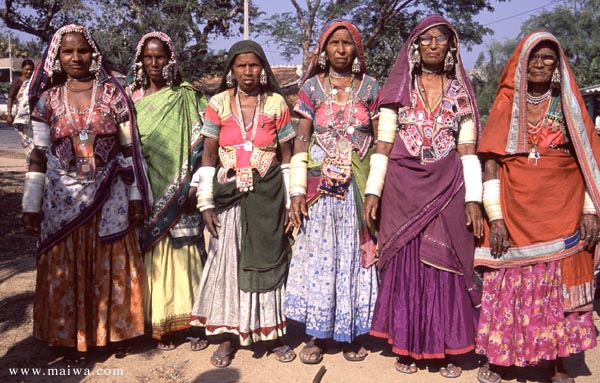
Banjara women visited in 2004
In 2000 and 2001 Maiwa made its first trips to try find the peoples who had made this embroidery. At the time we could encounter women in the marketplace dressed in the distinctive style. Large mirrors were set beside cowrie shells, and the ground was embroidered with red, yellow and orange threads. Geometric shapes were prominent: triangles, squares, and circles. Bags had additional cowrie shell tassels and pressed-lead ornaments.

We did not know it clearly at the time, but we were looking to establish a relationship with a Banjara group that was the equivalent of the relationship we already had with the KMVS embroiderers of the Kutch Desert in western India.

After working with the KMVS (Kutch Mahila Vikas Sangathan) co-operative for years, Maiwa mounted a large-scale exhibition of embroidered work at the Vancouver Museum. Through the Eye of a Needle: Stories from an Indian Desert was one of the best attended displays in the Museums’ history and after an extended run, the embroideries, text panels, and artifacts went on tour to other institutions. The exhibition also led to a thirty minute long documentary film and a book.

Village politics are complicated, but we knew that in order for a new project to succeed, there needed to be at least three things

The Banjara visited in 2005
1) Elder craftswomen, who are respected and who still have traditional embroidery skills. 
2) Younger craftswomen who want to learn these skills and see the value of continuing traditional work, 
3) The support of the larger cultural group i.e, the village or a cooperative.

Our method of working involved contacting a group that seemed to meet these three requirements. We would then invest in source materials for a project (threads, fabric, cloth, and mirrors) and give an advance on the completed pieces. The advance showed trust and also served to give an indication of the value of skilled work.

Contemporary business thinking does not encourage this model. A business is supposed to unload as much risk as possible onto the makers, and then squeeze them for lower prices. But we were not out to merely run a business. We were determined to encourage a system that would see the continuation of one of the most impressive embroidery traditions in the world.

Traditional dress and adornment.

Our search for a group to work with continued for five more years.

In 2004, as part of the very first Maiwa Symposium, we partnered with Vancouver chef John Bishop to hold the “Genius of Origins” event. The combination fashion show, sit-down diner was an ambitious fundraiser for the Maiwa Foundation. It was a success. It was also the first time the Banjara cultural group was clearly identified as an ongoing project for both Maiwa and the Maiwa Foundation.

We returned to India villages in 2005 and again in 2006. We investigated co-operatives and NGOs that might be able to provide on-the-ground support.

Meena demonstrates a stitch.
In 2006 we brought Meena Raste with us. Meena was our main contact at KMVS and it was with Meena that we worked to produce the Vancouver Museum exhibition, Through the Eye of a Needle.

India in 2006 was experiencing an economic boom. The price of real-estate was on the rise and many people in rural areas were being encouraged to sell what they had to developers. The sudden wealth meant that there was little interest in developing embroidery for income generation.

Over the next few years we experienced a number of disappointments, but we did not give up hope. During this time we saw the supply of traditional Banjara embroidery slowly disappear from the markets. The quality of pieces went down as the prices went up. What might have started out as a larger piece of embroidery was often cut up and sold, sometimes as a fragment, and sometimes remade into a bag or cushion.

One day the break we were waiting for came in the form of a message from Meena.

In 2008 Meena told us that an “unusual couple” had founded a trust to preserve Banjara Embroidery. The couple, a French man and a woman from the Banjara community, lived near Hampi in central India. It would not be easy to get there to visit, but they seemed dedicated. The founders were Jan and Laxmi Duclos and together they ran the Surya Lambhani-Banjara Women’s Welfare Trust or Surya's Garden.

Our first contact with them came in the mail. Jan wrote to us in an elegant longhand telling us about the project, explaining the difficulties they faced and strongly encouraging us to visit.

Laxmi in 2009
In 2009, Maiwa made the decision to see the author of the hand-written letters. Charllotte Kwon and Shirley Gordon, made the drive from Goa to Hampi. On a map Goa and Hampi are fairly close. The trip should have been 5 hours – but it lasted 17. This only afforded a short visit with Jan and Laxmi. After that first contact Charllotte Kwon called Vancouver, “We may just have found the group that we’ve been looking for.” she said, trying hard to curb her enthusiasm – trying hard not to be too hopeful after so many disappointments.

That 2009 visit, did not take place in isolation. On that same trip to India, the Maiwa Foundation conducted a week-long natural dye workshop in Assam. Charllotte had just finished conducting a 21-day tour to visit artisans. The tour covered almost the entire north of India from Kutch, to Bengal. There were also many other stops to visit blockprinters, dyers and the Jawaja leatherworkers.

We decided we wanted to work with the group. Now it was simply a matter logistics, designs, sizes, backing fabrics, embroidery threads, timelines, and of course, costing. Maybe to facilitate this new project we didn’t need another Meena, maybe what we needed was Meena herself.

Talking stitches on the porch of Surya's Garden, Hampi.
In 2011 the Maiwa Foundation had just completed a Masterclass workshop held in Bengal. Meena was a participant and so we arranged to regroup in Hampi. We had a substantial team together and we took full advantage of our visit. Meena assisted the group with costing estimates and several options for backing materials. After much discussion it was agreed that KMVS and Surya’s garden could work together. KMVS could supply tailoring expertise and finish the works that Laxmi and Jan’s group had made.

This was a leap of faith for everyone. It is no small thing to pack up pieces that had each taken many months to stitch, and ship them out to strangers in the hopes that they would complete them.

The results of this partnership arrived at Maiwa in September of 2012. Twelve years had passed between the conception of this project and the arrival of the first completed piece.

You are present at an historic moment in craft. Nowhere on earth will you find contemporary Banjara embroidery of this caliber. You are present at the beginning. The beginning of the revival.


Friday, October 19, 2012 2 comments


Maiwa Textile Symposium
presents:
 an exhibition of the best contemporary Banjara embroidery being done today.

BANJARA EMBROIDERY

EXHIBIT and LECTURE


Jan and Laxmi Duclos run the
Surya’s Lambhani Women Welfare Trust
(Surya’s Garden) in Hampi, India.
Together they are reviving some of India's
most distinctive embroidery.

7:30 pm
Saturday October 20
The NetLoft, Granville Island, Canada

Tickets available online
by phone 604 669 3939
at the Maiwa Stores
or at the door.

There are also two opportunities to take the
BANJARA EMBROIDERY WORKSHOP

October 19, 20 (Fri, Sat) 10am–4pm

October 21, 22 (Sun, Mon) 10am–4pm

click on the above links for full details and registration.


Monday, October 15, 2012 No comments
Meena Raste (right) trades stitches with one of the Banjara embroiderers (left)
Charllotte Kwon watches.
In Part 1 we identified some of the problems associated with costing embroidery. We closed the post with a hint that we had something on this trip that would be very helpful.
Saturday, April 02, 2011 No comments
Always check the ropes.
Two posts back we talked about Banjara Embroidery. We are picking up that thread again here.

It was already dark when we landed in Hubli, the closest airport to Hampi and Surya's Garden. We spent some time tying our luggage to the roof (some of it dislodged en-route, but never hit the ground, hanging, as it was, by the ropes). And we are off for a quick four or five-hour drive.
Wednesday, March 23, 2011 No comments
Maiwa and the Maiwa Foundation have been trying to work with traditional Banjara embroidery for a number of years now. We've had a long and successful relationship with KMVS in the Kutch desert of Gujarat, and we've hoped to implement that model to the exquisite and bold Banjara embroidery.

Banjara community visited in 2004.
The Banjara (sometimes called Lambani or Lambada) are a semi-nomadic people who reside mostly in Southern and Middle India. They share a common ancestry with the Roma. who migrated through the mountains of Afghanistan and settled in the deserts of Rajasthan. Since the 12th century, the Banjaras have gradually traveled down to the south and large numbers worked for the Moghuls transporting provisions and trading goods. They traveled with herds of thousands of pack bullocks, buying and selling sugar, salt, and grain. Their habit of living in isolated groups away from others, which was a characteristic of their nomadic days, still persists.
Saturday, March 12, 2011 No comments
Older Posts

Subscribe to our mailing list

* indicates required
Send me emails about Maiwa

Labels

Bags & Pouches Bandanas Banjara Bedding Bengal Weaving Block Print Dyeable Blanks Dyeable Clothing Embroidery Embroidery Supplies Exhibition Free Resources Handwoven Interiors Jawaja Carpets Jawaja Leather Kala Cotton Lecture Maiwa Books Maiwa Foundation Maiwa School of Textiles Merchant & Mills Natural Dye Kits Natural Dyes Quiet Manifesto Quilts & Blankets Scarves & Shawls Slow Clothes Table Cloths & Napkins Travel Yardage indigo

About Maiwa

Find out Who We Are ...

Voices On Cloth

Maiwa Podcasts


Maiwa Podcasts

Follow Us

Popular Posts

  • Natural Dyes - About The Organic Indigo Vat
    The Maiwa Guide to Natural Dyes What they are and how to use them These organic vats were originally developed by French dye chemist and...
  • Natural Dyes - Mordants Part 1
    The Maiwa Guide to Natural Dyes What they are and how to use them We've divided the section on Mordants into three parts. We start...
  • Natural Dyes - Mordants Part 3
    The Maiwa Guide to Natural Dyes What they are and how to use them Cotton mordanted with alum. How To Mordant Here we give the pro...
  • Natural Dyes - Scouring
    The Maiwa Guide to Natural Dyes What they are and how to use them Proper scouring is absolutely essential to good dyeing. Improperly sc...
  • Natural Dyes - Mordants Part 2
    The Maiwa Guide to Natural Dyes What they are and how to use them In our previous post we explained why mordanting was necessary and l...
  • Natural Dyes - Indigo, The Fruit Vat
    The Maiwa Guide to Natural Dyes What they are and how to use them This post give the recipe and procedure to make an organic indigo vat...
  • Natural Dyes - Indigo
    The Maiwa Guide to Natural Dyes What they are and how to use them Natural indigo is obtained from indigo bearing plants, the most si...

Blog Archive

  • ▼  2026 (82)
    • ▼  October (1)
      • Our Studio Jacket is Back! — Handwoven & Naturall...
    • ►  September (11)
    • ►  August (8)
    • ►  July (9)
    • ►  June (9)
    • ►  May (10)
    • ►  April (10)
    • ►  March (9)
    • ►  February (6)
    • ►  January (9)
  • ►  2025 (115)
    • ►  December (11)
    • ►  November (11)
    • ►  October (11)
    • ►  September (9)
    • ►  August (11)
    • ►  July (11)
    • ►  June (8)
    • ►  May (9)
    • ►  April (10)
    • ►  March (7)
    • ►  February (8)
    • ►  January (9)
  • ►  2024 (108)
    • ►  December (11)
    • ►  November (9)
    • ►  October (9)
    • ►  September (8)
    • ►  August (11)
    • ►  July (9)
    • ►  June (6)
    • ►  May (9)
    • ►  April (10)
    • ►  March (8)
    • ►  February (9)
    • ►  January (9)
  • ►  2023 (108)
    • ►  December (12)
    • ►  November (6)
    • ►  October (9)
    • ►  September (8)
    • ►  August (12)
    • ►  July (8)
    • ►  June (9)
    • ►  May (9)
    • ►  April (9)
    • ►  March (9)
    • ►  February (8)
    • ►  January (9)
  • ►  2022 (111)
    • ►  December (13)
    • ►  November (9)
    • ►  October (8)
    • ►  September (9)
    • ►  August (11)
    • ►  July (8)
    • ►  June (9)
    • ►  May (9)
    • ►  April (9)
    • ►  March (10)
    • ►  February (8)
    • ►  January (8)
  • ►  2021 (105)
    • ►  December (9)
    • ►  November (9)
    • ►  October (9)
    • ►  September (8)
    • ►  August (8)
    • ►  July (8)
    • ►  June (11)
    • ►  May (9)
    • ►  April (10)
    • ►  March (8)
    • ►  February (8)
    • ►  January (8)
  • ►  2020 (94)
    • ►  December (11)
    • ►  November (12)
    • ►  October (11)
    • ►  September (9)
    • ►  August (7)
    • ►  July (9)
    • ►  June (7)
    • ►  May (8)
    • ►  April (9)
    • ►  March (4)
    • ►  February (1)
    • ►  January (6)
  • ►  2019 (69)
    • ►  December (7)
    • ►  November (4)
    • ►  October (6)
    • ►  September (11)
    • ►  August (3)
    • ►  July (5)
    • ►  June (4)
    • ►  May (5)
    • ►  April (5)
    • ►  March (7)
    • ►  February (5)
    • ►  January (7)
  • ►  2018 (71)
    • ►  December (6)
    • ►  November (5)
    • ►  October (14)
    • ►  September (6)
    • ►  August (5)
    • ►  July (5)
    • ►  June (6)
    • ►  May (7)
    • ►  April (5)
    • ►  March (2)
    • ►  February (5)
    • ►  January (5)
  • ►  2017 (73)
    • ►  December (6)
    • ►  November (8)
    • ►  October (11)
    • ►  September (10)
    • ►  August (7)
    • ►  July (7)
    • ►  June (4)
    • ►  May (5)
    • ►  April (6)
    • ►  March (3)
    • ►  February (4)
    • ►  January (2)
  • ►  2016 (47)
    • ►  December (4)
    • ►  November (4)
    • ►  October (5)
    • ►  September (12)
    • ►  July (2)
    • ►  June (2)
    • ►  May (4)
    • ►  April (2)
    • ►  March (3)
    • ►  February (5)
    • ►  January (4)
  • ►  2015 (136)
    • ►  December (5)
    • ►  November (35)
    • ►  October (13)
    • ►  September (12)
    • ►  August (3)
    • ►  July (5)
    • ►  June (5)
    • ►  May (19)
    • ►  April (28)
    • ►  March (3)
    • ►  February (3)
    • ►  January (5)
  • ►  2014 (93)
    • ►  December (1)
    • ►  November (2)
    • ►  October (10)
    • ►  September (10)
    • ►  July (1)
    • ►  June (4)
    • ►  May (26)
    • ►  April (27)
    • ►  March (3)
    • ►  February (3)
    • ►  January (6)
  • ►  2013 (112)
    • ►  December (2)
    • ►  November (1)
    • ►  October (7)
    • ►  September (8)
    • ►  August (8)
    • ►  July (5)
    • ►  June (3)
    • ►  May (11)
    • ►  April (52)
    • ►  March (3)
    • ►  February (5)
    • ►  January (7)
  • ►  2012 (108)
    • ►  December (5)
    • ►  November (5)
    • ►  October (8)
    • ►  September (10)
    • ►  August (3)
    • ►  July (6)
    • ►  June (2)
    • ►  May (25)
    • ►  April (27)
    • ►  March (7)
    • ►  February (5)
    • ►  January (5)
  • ►  2011 (126)
    • ►  December (4)
    • ►  November (3)
    • ►  October (11)
    • ►  September (9)
    • ►  August (3)
    • ►  July (6)
    • ►  June (5)
    • ►  May (39)
    • ►  April (23)
    • ►  March (8)
    • ►  February (8)
    • ►  January (7)
  • ►  2010 (123)
    • ►  December (8)
    • ►  November (8)
    • ►  October (6)
    • ►  September (11)
    • ►  August (7)
    • ►  July (9)
    • ►  June (16)
    • ►  May (17)
    • ►  April (15)
    • ►  March (10)
    • ►  February (7)
    • ►  January (9)
  • ►  2009 (141)
    • ►  December (7)
    • ►  November (11)
    • ►  October (13)
    • ►  September (10)
    • ►  August (12)
    • ►  July (11)
    • ►  June (11)
    • ►  May (29)
    • ►  April (32)
    • ►  March (5)